Why Employees Are the Biggest Cybersecurity Risk in 2026
Biggest Cybersecurity Risk
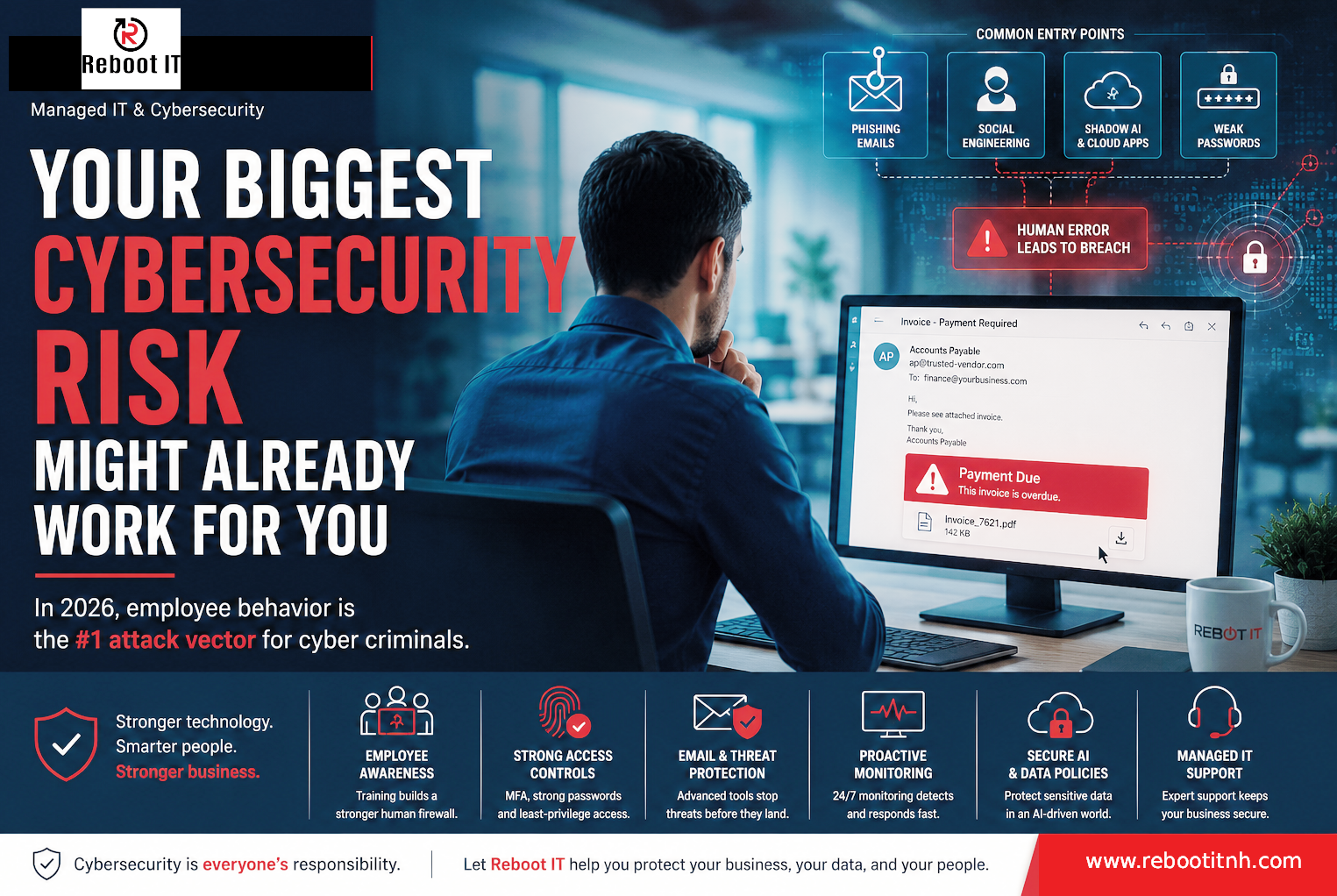
Most business owners imagine cyber attacks as highly sophisticated hackers breaking through firewalls and security systems.
In reality, many modern cyber attacks begin with something much simpler:
A single employee clicking the wrong email.
In 2026, employees have become one of the biggest cybersecurity risks facing businesses not because they are careless or malicious, but because cybercriminals are increasingly targeting human behavior instead of technology itself.
Today’s attacks are designed to exploit trust, urgency, distraction, and routine workplace habits. According to multiple cybersecurity studies, human error continues to contribute to a large percentage of successful cyber incidents worldwide.
Even businesses with strong security systems can become vulnerable when human error enters the equation.
The Rise of Human-Focused Cyber Attacks
Cybercriminals are no longer relying only on brute-force hacking methods. Modern attacks are smarter, more personalized, and often powered by artificial intelligence.
Businesses are now facing:
- AI-generated phishing emails
- Deepfake voice scams
- Fake login portals
- Business email compromise attacks
- Social engineering tactics
- Unauthorized AI tools and applications
Attackers frequently target businesses using platforms like Microsoft 365 and Google Workspace because employees rely on them every day.
In many cases, attackers no longer need to “hack into” a business.
Employees unknowingly become the entry point.
One Click Can Create Major Damage
Imagine an employee receiving what appears to be a legitimate invoice from a trusted vendor.
The email looks professional.
The branding appears real.
The request seems urgent.
One click on a malicious attachment can expose passwords, financial information, sensitive client data, or even lock down an entire company network through ransomware.
This is exactly why cybercriminals continue targeting employees first.
Human error remains one of the fastest ways into a business environment.
Small Businesses Are Prime Targets
Many small and medium-sized businesses believe cybercriminals only target large corporations.
Unfortunately, smaller businesses are often seen as easier opportunities.
Why?
Because many businesses still struggle with:
- limited IT resources
- outdated systems
- inconsistent employee training
- weak password practices
- lack of monitoring and security oversight
Cybercriminals understand this.
A single successful phishing email can disrupt operations, damage customer trust, and create significant financial losses for a growing business.
The Growing Risk of “Shadow AI”
One of the newest cybersecurity concerns in 2026 is the rise of Shadow AI.
Employees are increasingly using AI platforms such as ChatGPT and Microsoft Copilot without company approval or security oversight. While these tools improve productivity, they can also unintentionally expose sensitive business information.
Examples include:
- uploading confidential files into AI chatbots
- sharing internal company data with external AI tools
- using unauthorized cloud applications
- storing sensitive information outside secure systems
Without proper policies and monitoring, businesses may not even realize where their data is being shared.
Technology Alone Is No Longer Enough
Many companies assume cybersecurity is solved simply by purchasing software or installing security tools.
But technology alone cannot stop poor security habits.
Even advanced systems can fail when:
- passwords are reused
- suspicious links are opened
- MFA is ignored
- sensitive files are shared improperly
- unsecured devices connect to company networks
Modern cybersecurity strategies often combine tools from providers such as Cisco, Microsoft Defender, and CrowdStrike alongside employee awareness training and proactive monitoring.
Cybersecurity is no longer just an IT issue.
It is a business-wide responsibility.
How Businesses Can Reduce Employee Cyber Risk
The good news is that employee-related cybersecurity risks can be significantly reduced with the right strategy.
Businesses should focus on:
- ongoing cybersecurity awareness training
- strong password policies
- multi-factor authentication (MFA)
- proactive monitoring
- email security protection
- limited access permissions
- secure AI usage policies
- managed IT support
The strongest cybersecurity strategies combine both technology and employee awareness.
Final Thoughts
The biggest cybersecurity threat in 2026 is no longer just technology it is human behavior.
As cyber attacks become more advanced and AI-driven, businesses must evolve beyond basic security tools alone. Companies that invest in employee awareness, proactive IT management, and modern cybersecurity strategies will be far better prepared for the evolving threat landscape.
At Reboot IT, we help businesses strengthen both their technology and their people through proactive IT support, cybersecurity solutions, monitoring, and employee-focused security strategies.
Because protecting a business today means protecting the people behind it.