
Blog
Stay informed with the latest IT insights, tips, and trends from Reboot IT. Our blog covers a wide range of topics to help businesses in New Hampshire, Maine, and Massachusetts stay ahead in the ever-evolving world of technology.
Why Local Businesses in New Hampshire Need Proactive IT Support in 2026
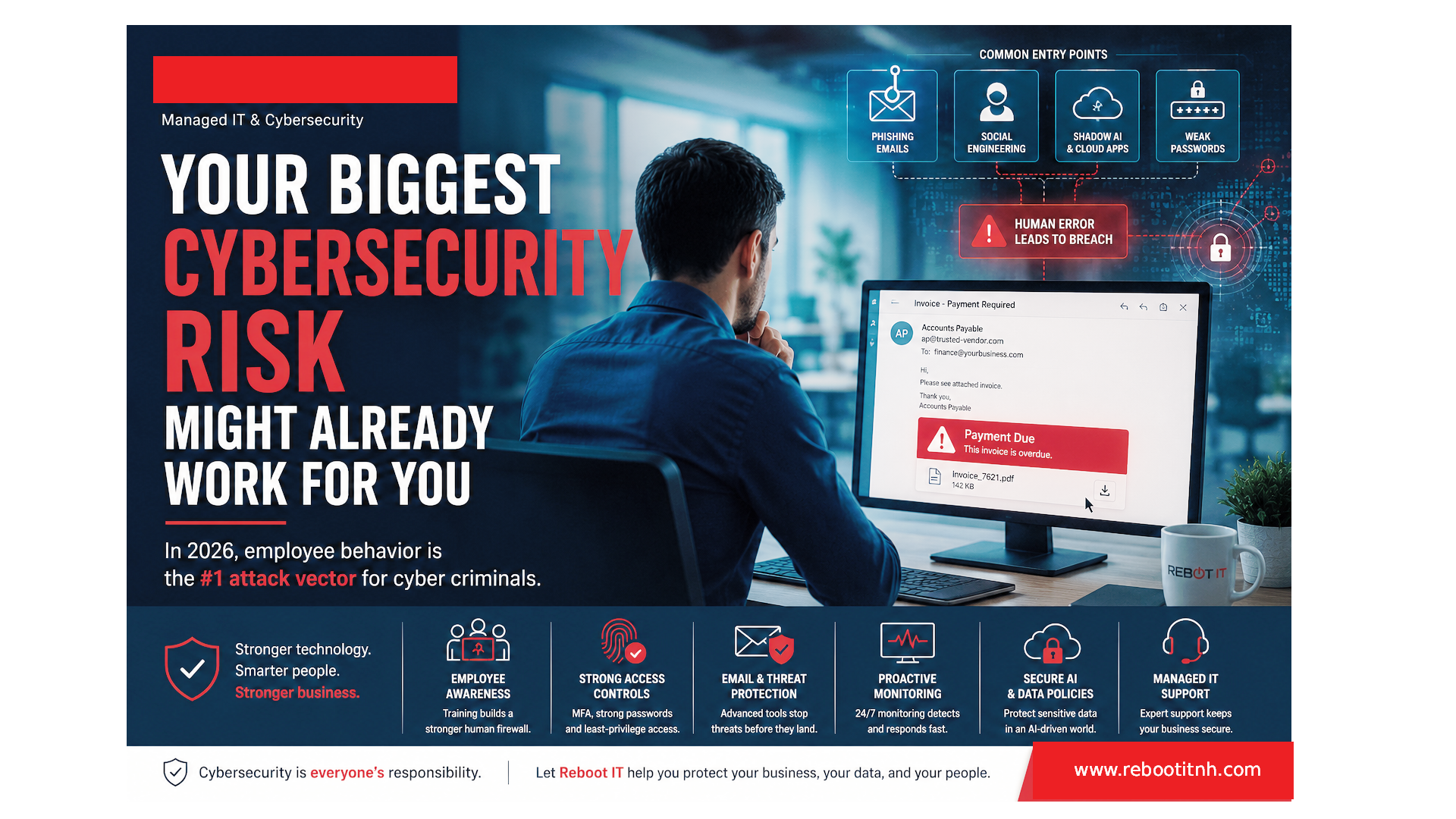
biggest cybersecurity risk facing businesses in 2026. human error, phishing attacks, and AI-driven threats put companies at risk and how to protect your business

Introduction Achieving CMMC compliance can feel overwhelming for small businesses, especially with evolving cybersecurity threats and strict requirements. At Reboot IT , we simplify the process with a structured CMMC risk assessment methodology designed to identify vulnerabilities, reduce risk, and ensure compliance. In this guide, we break down the exact steps your business can take to protect its systems and meet CMMC standards. 1. Identify Critical Assets The first step is understanding what needs protection. Without this, nothing else works. This includes: Controlled Unclassified Information (CUI) Systems and networks Employee devices and access points 👉 Learn more about our CMMC Compliance Services 2. Assess Your Current Security Posture Next, evaluate your current cybersecurity setup to identify weaknesses. Review: Firewalls and endpoint protection Access controls and authentication Security policies and procedures 👉 Explore our Cybersecurity Assessments 3. Identify Risks & Vulnerabilities Now it’s time to uncover gaps in compliance. Common issues include: Weak passwords or no MFA Outdated software Lack of employee training 👉 Also read: Top CMMC Threats for Small Businesses 4. Implement Security Controls Once risks are identified, apply the necessary CMMC security controls. This may include: Multi-factor authentication (MFA) Endpoint protection and monitoring Data encryption and backups This step is where compliance starts becoming reality. 5. Continuous Monitoring & Improvement CMMC compliance is not one-and-done it’s ongoing. To stay compliant: Monitor systems regularly Conduct audits Update policies as threats evolve Why This Methodology Matters Without a structured approach, businesses often: Miss critical vulnerabilities Fail compliance audits Spend more fixing problems later A proven methodology ensures efficiency, security, and long-term compliance. Stay CMMC Compliant with Reboot IT At Reboot IT, we guide small businesses through every step from assessment to full compliance. Ready to secure your business? Contact Reboot IT today for a full assessment.

Learn the top CMMC cybersecurity threats in 2026 and how your small business can stay compliant. Expert guidance from Reboot IT.

Learn how agentic AI is creating new cybersecurity risks in 2026 and how small businesses can stay protected. Expert IT support from Reboot IT.

# CMMC Compliance FAQ: What DoD Contractors Need to Know If your business works with the U.S. Department of Defense (DoD) or supports the defense supply chain especially companies based in New Hampshire or the surrounding region the Cybersecurity Maturity Model Certification (CMMC) Final Rule directly impacts you. Below are answers to the most common questions businesses ask when preparing for CMMC compliance. --- What is CMMC? CMMC (Cybersecurity Maturity Model Certification) is a DoD program designed to ensure contractors protect sensitive government information. It establishes standardized cybersecurity requirements that must be met before handling Federal Contract Information (FCI) or Controlled Unclassified Information (CUI). Is CMMC mandatory now? Yes. As of **November 10, 2025**, CMMC is a contractual requirement under DFARS for applicable DoD contracts. Organizations that do not meet required CMMC levels may be ineligible for new contracts, renewals, or option years. Who needs to comply with CMMC? CMMC applies to: Prime contractors Subcontractors Small and mid-sized businesses Any organization handling FCI or CUI within the DoD supply chain If you touch sensitive DoD data in any capacity, CMMC likely applies to you. What are the CMMC levels? There are three CMMC levels: Level 1 Basic cybersecurity practices to protect Federal Contract Information (FCI). Level 2 Advanced protection for Controlled Unclassified Information (CUI), aligned with NIST SP 800-171. Level 3 Expert-level cybersecurity practices for high-risk CUI, aligned with NIST SP 800-172. How do I know which CMMC level applies to my business? Your required CMMC level depends on: The type of information you handle (FCI vs CUI) Your contract requirements Flow-down requirements from prime contractors Reboot IT helps businesses determine their required level by reviewing contracts, data flows, and system scope. What happens if my business is not CMMC compliant? If you are not compliant: You may lose eligibility for DoD contracts Contract renewals and options may be denied You risk removal from future solicitations Non-compliance can quickly become a barrier to growth for defense contractors. What is SPRS and why does it matter? The Supplier Performance Risk System (SPRS) is where CMMC compliance status is tracked. Organizations must submit assessments and provide annual affirmations of continuous compliance. Contracting officers use SPRS to verify eligibility. Is CMMC a one-time certification? No. CMMC requires ongoing compliance . Organizations must: Maintain security controls year-round Monitor systems continuously Update documentation regularly Submit annual affirmations CMMC is an ongoing cybersecurity program not a one-and-done audit. How long does it take to become CMMC compliant? Timelines vary depending on: Your current cybersecurity posture Required CMMC level Scope of systems handling FCI or CUI For many small and mid-sized businesses, preparation can take several months. Starting early reduces cost, stress, and risk. How can Reboot IT help with CMMC compliance in New Hampshire? Reboot IT supports New Hampshire-based defense contractors and SMBs at every stage of the CMMC journey, including: CMMC gap assessments Readiness and remediation planning Policy and documentation support Security control implementation Ongoing monitoring and compliance support We simplify complex requirements and guide you step-by-step toward CMMC readiness. When should my business start preparing? Now. Even with phased enforcement through 2028, some contracts may require compliance earlier. Businesses that prepare ahead of time gain a competitive advantage and avoid last-minute compliance scrambles. Get Started with Reboot IT in New Hampshire CMMC compliance doesn’t have to be overwhelming. Reboot IT helps businesses prepare, implement, and maintain CMMC readiness so they can stay eligible, secure, and competitive. Contact Reboot IT today to schedule a CMMC readiness assessment for your New Hampshire business.

Cloud computing isn’t just about hosting applications anymore. In 2026, cloud strategy is inseparable from security, compliance, automation, and cost management. For small and mid-sized businesses in New Hampshire, the right cloud approach can improve efficiency, reduce risk, and ensure compliance all while keeping costs predictable. Here’s a look at the top cloud trends shaping 2026 and what your business should focus on. 1️⃣ AI-Driven, Self-Optimizing Cloud Platforms Cloud platforms are getting smarter. AI now automates tasks, detects anomalies, and optimizes performance in real time. Businesses that leverage AI-driven cloud can: Detect and fix issues faster Optimize workloads automatically Improve uptime and efficiency ⚠️ Tip: Automation without governance can backfire. Clear policies are essential to keep AI aligned with business goals. 2️⃣ Governance & Compliance Take Center Stage Cloud complexity is increasing, especially for businesses handling sensitive data or working with government contracts. In 2026, businesses will prioritize: Visibility across cloud workloads Policy enforcement ®gulatory compliance (CMMC, NIST, HIPAA) Accountability & risk management Strong governance lets you innovate without losing control. 3️⃣ Data Trust Becomes a Competitive Advantage Data is only valuable if it’s accurate, secure, and accessible. Businesses that manage data well can: Make better decisions faster Ensure compliance with regulations Reduce operational friction Cloud-native tools for data governance and monitoring are now essential. 4️⃣ Cloud Security Evolves to Counter AI-Driven Threats Cloud is getting smarter and so are attackers. AI-powered attacks, automated phishing, and credential exploitation are on the rise. Businesses need: Continuous security monitoring Built-in platform security Proactive threat detection & response Security is no longer optional it must be designed into the cloud from day one. 5️⃣ Identity Is the New Security Perimeter As cloud workloads scale, identity becomes the key to secure access. Strong identity and access management (IAM) reduces exposure and limits damage during incidents. Zero-trust and identity-first strategies are quickly becoming standard practice for New Hampshire businesses. 6️⃣ Cloud Cost Management Expands Beyond Infrastructure AI workloads bring unpredictable costs. Businesses are adopting FinOps strategies to: Monitor cloud and AI spending Align costs with business value Prevent surprises in cloud budgets A smart cloud strategy balances innovation with financial sustainability. 7️⃣ Multi-Cloud Strategies Increase Flexibility & Resilience Avoiding vendor lock-in and improving resilience requires multi-cloud approaches. Using multiple providers lets businesses: Match workloads to the best services Improve redundancy Negotiate better pricing ⚠️ Without centralized oversight, multi-cloud complexity can grow quickly. Staying Ahead With Reboot IT The cloud landscape in 2026 will reward businesses that combine automation, governance, security, and cost discipline. At Reboot IT, we help New Hampshire businesses: Design and manage cloud environments Ensure compliance with CMMC, NIST, and HIPAA Secure sensitive data against evolving threats Optimize costs while improving operational efficiency Contact Reboot IT today to see how your business can take advantage of these cloud trends while staying secure, compliant, and competitive.

Technology is no longer just a “back-office” function for small businesses it’s the backbone of daily operations. From cybersecurity threats to remote work and cloud reliance, many businesses are realizing that reactive IT support is no longer enough. In 2026, more small and mid-sized businesses are shifting toward proactive IT management to reduce downtime, protect data, and support growth. The Problem With “Break-Fix” IT For years, many businesses relied on IT support only when something broke. While this approach might seem cost-effective, it often leads to: Unexpected downtime and lost productivity Security vulnerabilities left unaddressed Slow response times during critical issues No long-term technology strategy When systems fail, businesses pay not just in repair costs but in lost revenue and trust. Cybersecurity Is No Longer Optional Cyber threats are increasing, and small businesses are no longer “too small to target.” Phishing, ransomware, and data breaches affect organizations of all sizes. Modern IT support focuses on: Ongoing system monitoring Regular security updates and patching Employee cybersecurity awareness Data backup and disaster recovery planning A single incident can be costly prevention is always cheaper than recovery. Supporting Remote and Hybrid Work Remote and hybrid work models are now standard for many companies. Without reliable IT infrastructure, businesses struggle with: Secure remote access Device management Cloud collaboration tools Consistent support for off-site teams Proactive IT support ensures employees can work efficiently wherever they are. How Managed IT Services Support Business Growth Managed IT services go beyond fixing issues. They provide businesses with: Predictable monthly IT costs Reduced downtime through proactive maintenance Scalable solutions that grow with the business Strategic guidance aligned with business goals Instead of reacting to problems, businesses gain a technology partner invested in long-term success. Why Businesses Choose Reboot IT At Reboot IT, we help small businesses simplify technology, strengthen security, and stay productive. Our approach is proactive, practical, and tailored not one-size-fits-all. Whether you need fully managed IT services, cybersecurity support, or on-demand help, we’re here to keep your systems running smoothly so you can focus on your business. Ready to Future-Proof Your IT? If your business is experiencing frequent IT issues, security concerns, or growing technology demands, it may be time for a smarter approach. Contact Reboot IT today to learn how proactive IT support can protect your business and support growth in 2026 and beyond.

Cloud Solutions • Reboot IT • 03.12.2025 As more businesses modernize their IT environments, the cloud has become a foundation for digital transformation. But one question still comes up almost every day: Should your organization choose a public cloud or a private cloud? Both offer scalability, efficiency, and cost savings but understanding the differences is essential for choosing the right environment that matches your performance, security, and compliance needs. What Is a Public Cloud? A public cloud is a shared environment managed by providers like Microsoft Azure, AWS, or Google Cloud. These platforms own the infrastructure, while businesses “rent” resources such as compute, storage, and networking. Benefits of the Public Cloud Scales instantly increase or decrease resources on demand. Cost-efficient pay only for what you use, with no hardware to purchase. Accessible anywhere perfect for remote or distributed teams. Rapid innovation benefit from continuous updates, automation, and new technologies. The tradeoff? Since resources are shared, customization is more limited, and businesses with strict regulatory requirements may face challenges. What Is a Private Cloud? A private cloud is a fully dedicated environment used by one organization only. It can live on-premises or in a hosted data center, but all resources are isolated and customizable. Benefits of a Private Cloud Maximum control & security ideal for sensitive data or heavily regulated industries. Customized performance optimized infrastructure for mission-critical workloads. Predictable costs consistent resource allocation for reliable budgeting. Stronger compliance alignment easier to meet frameworks like HIPAA, PCI-DSS, or GDPR. However, private cloud environments typically require more investment and ongoing management. Why Many Businesses Choose a Hybrid or Multi-Cloud Approach For many organizations, the answer isn’t public OR private it’s both. A multi-cloud strategy allows businesses to run sensitive or regulated workloads in a private cloud, while leveraging the public cloud for scale, agility, and cost efficiency. Why multi-cloud works: Balances security with performance Reduces operational costs Improves disaster recovery readiness Supports modern application development Avoids vendor lock-in Reboot IT’s Approach: Cloud Built Around Your Business Needs At Reboot IT, we know that no two businesses have the same operational, compliance, or budget requirements. That’s why we help clients design cloud strategies that deliver the right mix of performance, security, and cost efficiency. Whether you choose public, private, or multi-cloud, Reboot IT provides: 24/7 monitored, managed cloud environments Advanced cybersecurity protections built into every layer Compliance-aligned cloud architecture Cost governance to prevent unexpected bills Expert migration support and ongoing optimization We help businesses modernize their infrastructure, strengthen resilience, and unlock the full value of the cloud without the complexity. Choosing the Right Cloud Starts with Understanding Your Goals The decision between public and private cloud depends on: Data sensitivity Compliance requirements Performance needs Budget Future growth plans Reboot IT can help you evaluate your workloads, compare options, and build a cloud environment that supports security, innovation, and long-term business success. Ready to plan your cloud journey? Contact Reboot IT today to explore which cloud model is right for your organization.

A straightforward guide for manufacturers who want to protect their business, stay eligible for DoD contracts, and avoid the common CMMC pitfalls. For many small and midsize manufacturers, especially those connected to the defense industrial base, CMMC 2.0 can feel overwhelming. New rules, new terminology, new expectations and all on top of keeping operations running. But here’s the truth: CMMC isn’t just another requirement. Done right, it becomes a competitive edge. It shows maturity, builds trust with prime contractors, and keeps your business in the running for contracts others will lose. At Reboot IT, we support New England manufacturers who are trying to do the right thing every day protect their data, stay compliant, and stay in the supply chain. And while every business is unique, we see the same five mistakes repeated over and over. Not because leaders don’t care. But because the path to CMMC is complicated, confusing, and often surrounded by unnecessary fear. Let’s break it down and put you back in control. 1. We’re Too Small to Be Targeted. Reality: If you touch Controlled Unclassified Information (CUI) even a single document, you are in scope. Size doesn’t matter; attackers know SMBs are the easiest entry point into defense supply chains. Opportunity: By strengthening security now, you show prime contractors that you’re reliable, mature, and low risk. That trust leads to: More contract opportunities Faster onboarding Stronger long-term relationships 2. Expecting Internal Teams to Handle Everything Alone Reality: Most manufacturers run lean. IT teams are stretched thin. Asking your internal tech person (or a generalist MSP) to juggle CMMC readiness and day-to-day operations sets the stage for stress, delays, and missed requirements. Opportunity: Reboot IT gives manufacturers the structure, tools, and guidance needed to get compliant without burning out internal staff. You get: A dedicated compliance roadmap Managed security tools aligned with CMMC Experts who understand manufacturing, shop-floor realities, and DoD expectations Your team stays focused on production we handle the security. 3. Treating CMMC Like a One-Time Project Reality: Compliance doesn’t end once you “pass.” CMMC requires continuous maturity, annual affirmations, and full reassessments every 3 years. Many organizations rush to meet the minimum requirements… then slide backward because no one is maintaining the program. Opportunity: Reboot IT builds repeatable, auditable processes into your everyday operations: Policies that match how you actually work Regular reviews and updates A long-term roadmap that evolves with your company This keeps you compliant and future-proof. 4. Forgetting About the Shop Floor Reality: Outdated or unprotected OT systems (CNCs, PLCs, production monitors, etc.) often go overlooked. Many MSPs don’t know how to secure or segment these systems, leaving massive gaps. Opportunity: Reboot IT bridges the IT–OT divide. We secure everything from rugged shop-floor terminals to cloud ERP without slowing productivity. Because we understand one critical truth: If production stops, the business stops. 5. Choosing the Wrong IT or Compliance Partner Reality: Generic IT providers or one-size-fits-all solutions rarely work for manufacturers. They lack experience with CMMC, defense contracts, and shop-floor environments. Opportunity: Reboot IT specializes in manufacturing environments and compliance-driven IT. We provide: Fast support Clear communication Tools mapped directly to CMMC controls Local expertise (Littleton & New England) A partner who stays with you from readiness to certification and beyond We translate the complex into simple steps you can confidently act on. Bottom Line: CMMC Should Drive Growth Not Fear As a leader, your job is to steer the business not become a compliance expert. With the right guidance, CMMC becomes: A business-strengthening process A powerful trust signal A roadmap for long-term resilience A way to win and keep contracts Reboot IT gives you the clarity, structure, and support you need to make CMMC work for your business not against it.
Categories
Explore articles by category to find the topics most relevant to your business needs
Cybersecurity >
Cloud Computing >
IT Compliance >
Tech Trends >
Business IT Solutions >
Subscribe To Our Newsletter
Don’t miss out on the latest IT news and updates! Subscribe to the Reboot IT newsletter to receive our top articles and insights directly in your inbox.